









Biomaterials
Solutions for real production conditions
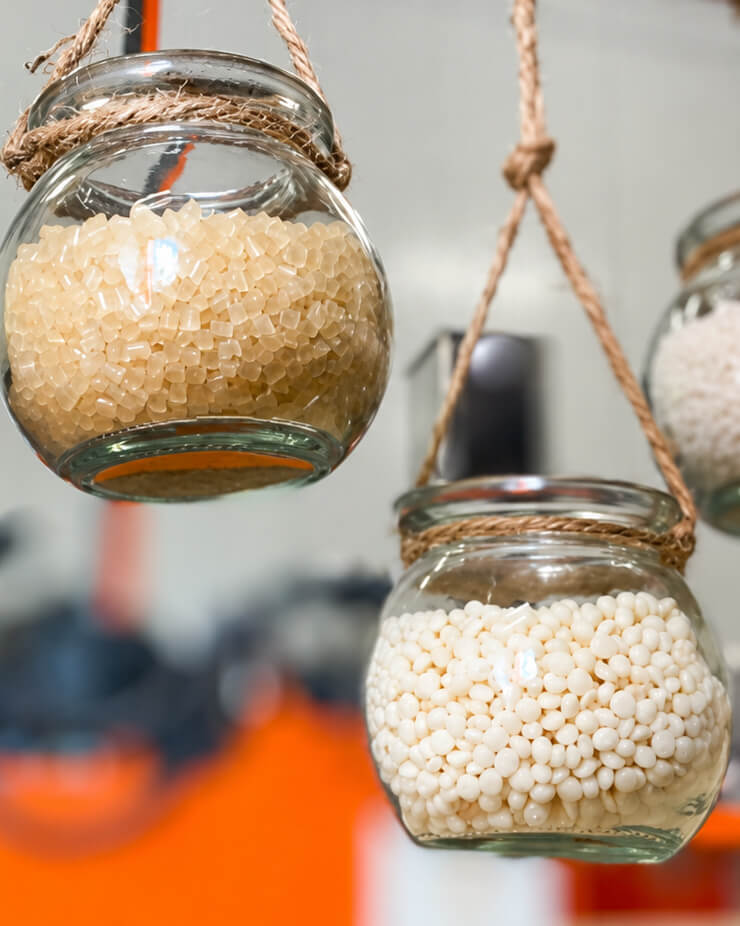
Our portfolio includes biopolymers and bioplastics in granulate form designed for B2B production – from processability and mechanical properties to the required end-of-life pathway.
Processability is excellent compared to the biomaterial alternatives we have run.
Trusted by manufacturers and industry partners






Biomaterials designed around real production requirements
The right biomaterial needs to meet more than sustainability requirements.
It needs to work with your production technology, deliver the required mechanical and thermal properties, and provide the right end-of-life pathway for the final application.
Our portfolio is built around these four areas:
Thermal and mechanical resistance
Selected blends offer high thermal and mechanical resistance, while properties can be adapted from rigid applications to more flexible solutions according to the project type.
Implementation into production
The portfolio covers injection moulding, extrusion, film blowing, thermoforming and other technologies. For selected types, simpler implementation without demanding production interventions is possible.
Compostability and functional end of life
Depending on the material type, industrial or home compostability, biodegradation in soil or water, or mechanical recycling is available.
European origin and technical consistency
We cooperate with European partners and materials with a focus on supply reliability, consistent quality and technical support during testing.
From material requirements to production testing
Define your requirements
Tell us your application, production technology, required properties and end-of-life requirements.
Select and test the material
We recommend suitable materials and provide samples for production trials.
Validate and scale
We support evaluation, fine-tuning if needed and the transition to regular supply.
Quick technical overview of our materials
- The final selection of bioplastic or biomaterial pellets always depends on the application, technology, thermal load and required end-of-life pathway.
| Category | Type line | Alternative to | Heat resistance | End of life* | Technologies* |
|---|---|---|---|---|---|
| Compostable | BP1 | PP, ABS, PC | 100+ °C | Recycl. 20% IC HC | IM TF EX CF EBM 3D |
| Compostable | BP2 | HDPE, LDPE | 60–90 °C | Recycl. 20% Water Soil IC HC | IM EX CF EBM 3D |
| Compostable | BP3 / BP4 | PP, PS, PE | 60–85 °C | Recycl. 20% IC | IM EX TF CF EBM |
| Compostable | BP5 | LDPE, LLDPE | Standard for films | Recycl. 20% Soil IC HC | FB IM |
| Drop-in | Bio-PP / Bio-PE / Bio-PET | Fossil PP, PE, PET | Identical to fossil-based materials | Mechanical recycling | All standard |
What our customers say
Processability is excellent compared to the biomaterial alternatives we have run.
- Italy
Finally a material that makes sense environmentally and economically at the same time.
BP4 gives us a combination of three things that usually do not come together: it processes well, the price works, and the heat resistance is where we need it.
- EU
The best part for us is that we did not need hot runners on our moulds. Apart from adjusting the processing parameters, the switch required no investment at all.
- EU
We are happy with BP2. It runs well and it degrades in all environments the way PHA-based materials do, but at a significantly better price.
- Italy
For our festival we needed a reusable material that would hold above 90 °C, because our dishwashers run up to 70 °C. That was not easy to find, but with Biopolymers Trade we found it. Thank you.
- Slovakia
Frequently asked questions
Do we need to modify injection moulding machines when switching to your biomaterials?
No, the machines do not need any special modifications. The moulds need to have standard hot runners suitable for biomaterials. However, we also have BP3 and BP4 grades, where hot runners are not required.
What is the difference between a bioplastic and a biopolymer?
A biopolymer is a polymer of biological origin. Bioplastic is a broader term – it can be bio-based, biodegradable, or both.
Importantly, bio-based does not automatically mean biodegradable or compostable. Materials such as Bio-PP, Bio-PE, and Bio-PET are bioplastics made partly or fully from renewable biological feedstocks, but they are not biodegradable or compostable. They have essentially the same properties and end-of-life pathways as their fossil-based equivalents.
Therefore, it is always important to distinguish between the material’s origin, its properties, and its end-of-life pathway. )
What is the difference between compostable BP blends and drop-in bio-plastics?
BP blends are designed for projects where compostability or another specific end-of-life pathway is decisive. Drop-in Bio-PP, Bio-PE and Bio-PET are bio-based materials chemically close to their fossil equivalents and are recycled in existing streams according to polymer type.
Are bioplastics suitable for reuse and industrial dishwashers?
Yes, for selected materials. However, suitability always depends on the specific application, product thickness, thermal load and operating conditions.
How will PCR materials help us with packaging and ESG goals?
PCR materials help increase the share of recycled content in products while supporting communication of circularity, traceability and more responsible material sourcing.
What do you do besides biomaterials and PCR?
In addition to materials, we also focus on biostimulants and biofertilizers for agriculture. This is a separate line focused on supporting soil, plants and reducing dependence on synthetic fertilizers.
How to choose between a compostable material, a material from renewable raw materials and a PCR material?
It depends on the product, technology, target market, required properties, price and whether you are looking for a bioplastic, bio-based plastic, PCR granulate or compostable material for a specific application. That is why we first evaluate the application for each project and only then recommend a specific material.
Ready to test a biomaterial for your application?
- Tell us your production technology and application requirements.
- We will help identify suitable biomaterials from our portfolio.
- Test selected materials in your production before moving to regular supply.